
Local SEO for Multi-Location Firms: The “Near Me” Strategy
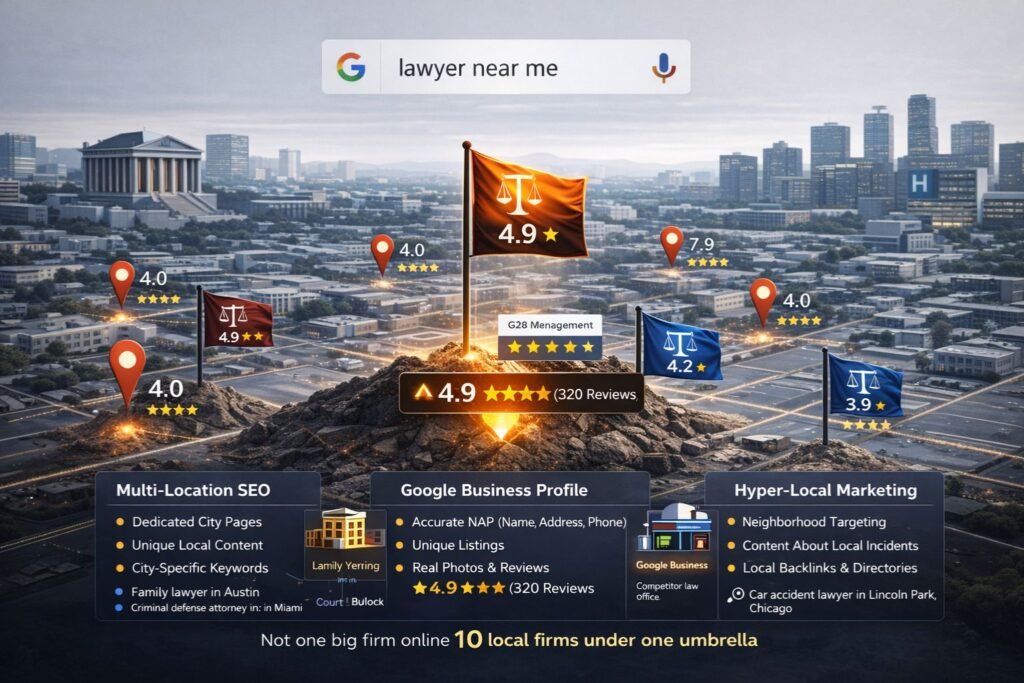
Why “Near Me” is the Game You Have to Win Search behavior has shifted. People don’t search like: “best law firm in the US” They search like: “immigration lawyer near me” “personal injury attorney in Brooklyn” “estate planning lawyer near me open now.” Google’s entire system—especially Google Business Profile—is built to serve proximity + relevance + trust. If you’re not optimized at the local level… you’re invisible. The Multi-Location Problem (That Most Firms Mess Up) Here’s the classic mistake: One website. One generic SEO strategy. Same content copied across city pages. Google sees that and goes: “Cool… but who are you helping in this city?” And just like that, you don’t rank anywhere. Multi-location law firm SEO isn’t about scaling content. It’s about scaling relevance. 1. Multi-Location Law Firm SEO = One Brand, Multiple Local Identities Each location needs to feel like its own digital office. That means: Dedicated location pages (not copy-paste clones) Unique local content (court systems, local laws, neighborhoods) City-specific keywords: “Family lawyer in Austin” “Criminal defense attorney in Miami” Think of it like this: You’re not one big firm online. You’re 10 local firms under one umbrella. 2. GMB Management for Franchises (This is Your Front Door) Your Google Business Profile listings are arguably more important than your website for local SEO. For each location: Unique listing (no duplicates, no overlaps) Accurate NAP (Name, Address, Phone) Real photos (not stock—Google knows) Consistent review generation And here’s the kicker: Reviews aren’t just social proof, they’re ranking fuel. If one location has 120 reviews and another has 5… guess which one Google trusts more? 3. Hyper-Local Legal Marketing: Go Smaller to Win Bigger Most firms aim too broadly. “Personal injury lawyer in Chicago” → insanely competitive But… “Car accident lawyer in Lincoln Park, Chicago” → now you’re playing smart Hyper-local legal marketing means: Targeting neighborhoods, not just cities Writing content about local incidents, courts, and trends Building local backlinks (community sites, local directories) It’s slower. But it sticks. 4. Geo-Fencing for Lawyers: Meet Clients Where They Already Are Now we step into modern territory. Geo-fencing lets you target users based on physical location—like: People visiting courthouses Competitor law offices Hospitals (for injury cases) It’s not SEO, but it amplifies your “near me” dominance. Imagine this: Someone visits a courthouse… and later sees your ad. That’s not luck. That’s positioning. 5. Ranking in Multiple Cities Without Cannibalizing Yourself This is where things get messy if you’re not careful. If multiple pages target the same keyword: Google gets confused… and no one ranks. So instead of: “Personal injury lawyer” everywhere You structure like: “Personal injury lawyer in Dallas” “Car accident attorney in Houston” “Truck accident lawyer in Austin” Each page = clear intent + unique angle No overlap. No confusion. 6. The Quiet Advantage: Systems Beat Effort Here’s the truth nobody likes to admit: You don’t win local SEO by working harder. You win by building systems. Automated review requests Consistent GMB posting Structured content rollout per location Lead tracking by city This is where most firms fall apart; they try to “manage” it manually. That doesn’t scale. Where GrowthX Fits In At GrowthX, the focus isn’t just traffic. It’s predictable pipelines. Because rankings don’t pay the bills. Signed clients do. So instead of: Random SEO tactics Generic location pages The approach is: Full local ecosystem per location Conversion-focused funnels Lead intake systems that don’t leak opportunities Final Thought “Near me” isn’t just a keyword. It’s a battlefield. And in that battlefield, the firms that win aren’t the biggest… They’re the most locally relevant, consistently visible, and system-driven. So the real question is: Are you trying to rank everywhere… Or actually show up where it matters? FAQs What are Local Service Ads for lawyers? Local Service Ads are Google advertising placements that appear above traditional search ads and operate on a pay-per-lead model. What does Google Screened mean for lawyers? The Google Screened badge indicates that an attorney has completed license verification and background checks required by Google. Why are LSA leads expensive in Washington DC? The DC legal market is highly competitive, which increases the cost per lead as firms compete for limited ad placements. Are LSA leads better than traditional PPC leads? They often involve higher intent because users frequently contact the firm directly from the ad interface. Do law firms need a strategy for Local Service Ads? Yes. Performance factors such as response time, reviews, and intake quality influence how leads are distributed.